CHALLENGE 02 • WIND, CHERGUI & SANDSTORMS
Protect buildings and daily use from hot winds and sandstorms.
At Guelmim, wind is not simply a dry breeze. Some events can combine hot air, dust and airborne sand, sharply reducing visibility and making outdoor conditions difficult.
The demonstrator must therefore test solutions that protect people, buildings, equipment, access routes and outdoor spaces without relying on heavy or energy-intensive systems.
SOLUTIONS TO VISUALISE

A bioclimatic unit exposed to a sandstorm, protected by landscape design, windbreaks, adapted vegetation and measures that reduce direct wind exposure.
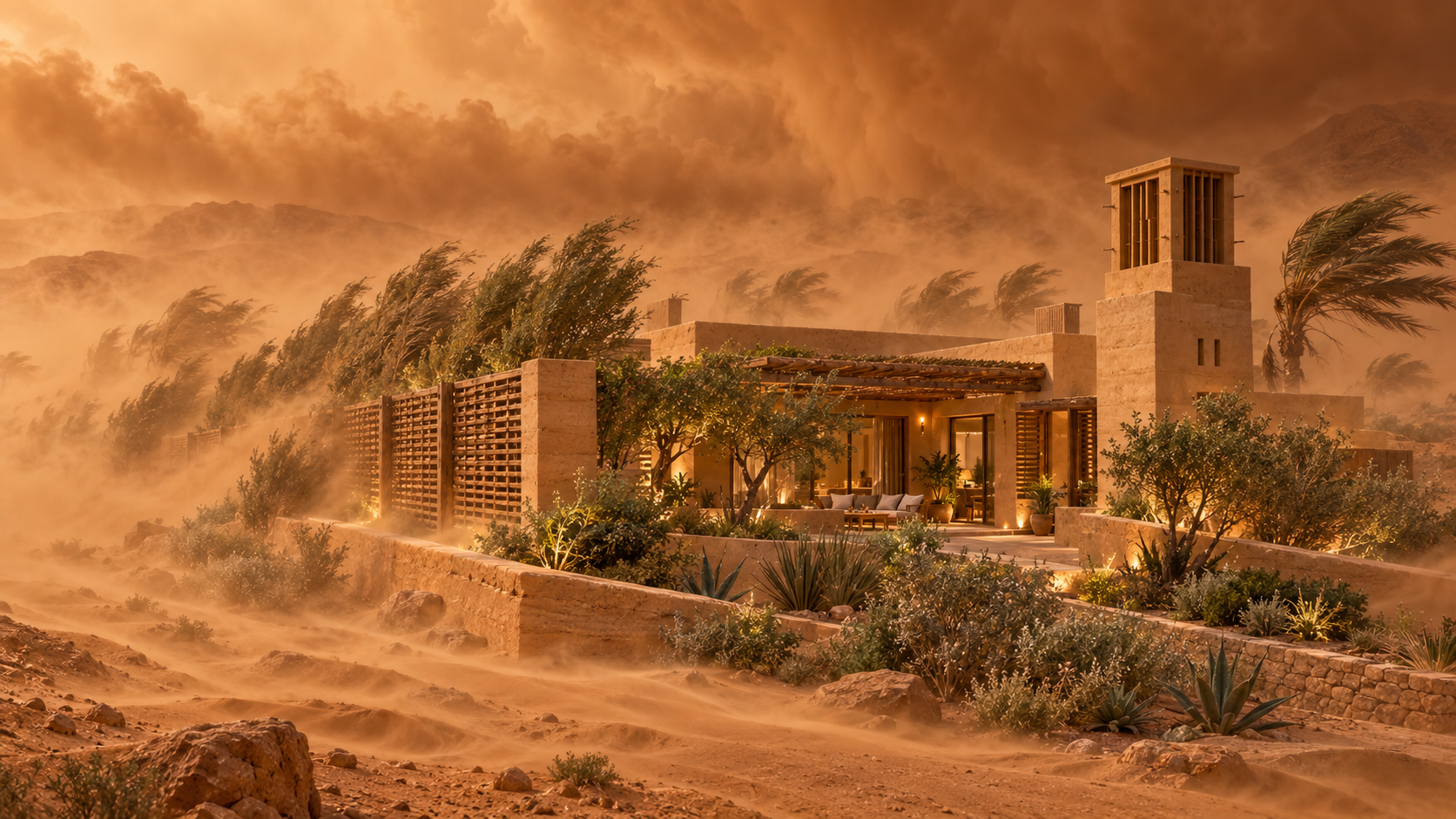
A progressive sandstorm-protection strategy that reduces wind speed through porous barriers, planting and land shaping before the airflow reaches occupied areas.
WHY THIS CHALLENGE?
A sandstorm is an operational risk, not only a visual phenomenon.
Windblown dust and sand can affect comfort, access, natural ventilation, openings, equipment, solar panels, outdoor areas and air quality.
When these events coincide with extreme heat, protection must be considered at several scales: landscape, building placement, envelope design, ventilation, filtration and maintenance.
Measurable objectives
• Wind speed before and after protection
• Sand and dust deposits
• Indoor air quality
• Temperature and comfort
• Equipment fouling
• Cleaning and maintenance frequency
• Continued usability of access routes and outdoor spaces
HOW CAN THE SITE BE PROTECTED?
Protection should work as a sequence of filters: slow the wind at the site perimeter, trap part of the sand load, create buffer zones, then protect buildings, access routes and sensitive equipment. The demonstrator will compare these measures under real conditions.

Concept illustration of a progressive sandstorm-protection strategy: porous windbreaks, adapted vegetation, land shaping, a second planted barrier and sheltered building placement.
SOLUTIONS TO TEST
Slow, deflect, filter and trap sand before it reaches occupied areas.
The strategy will be progressive: first act at site and landscape scale, then on building placement, envelopes and equipment. Several solutions can be combined and compared.
Porous windbreaks
Compare screens that allow part of the airflow through, reducing speed without creating strong turbulence.
Hedges & adapted planting
Use vegetation suited to arid conditions to create successive filters and slow the movement of sand.
Landforms & site shaping
Test berms, micro-relief, dry swales and landforms able to deflect or trap particles.
Building placement
Orient volumes, patios, walls and circulation paths to reduce direct exposure to prevailing winds and create sheltered areas.
Airlocks & protected entrances
Reduce sand entering buildings through recessed access, double doors, buffer zones and sheltered entrances.
Air filtration
Evaluate simple, maintainable systems for protecting indoor air during severe dust and sand events.
Equipment protection
Test protection and placement strategies for solar panels, machinery, air intakes, networks and fouling-sensitive equipment.
Cleaning & maintenance
Compare measures that reduce deposits, simplify cleaning and limit the amount of water required for maintenance.
RESEARCH & DEVELOPMENT
Turn the site into a sandstorm-protection laboratory.
The demonstrator can host prototypes, materials, landscape devices, sensors and filtration solutions proposed by partners.
Each experiment can be documented through weather conditions, sand behaviour, protection efficiency, maintenance requirements and user feedback.
We are looking for additional solutions
Companies, architects, landscape designers, manufacturers, researchers, engineering consultancies and laboratories may propose proven or experimental systems for full-scale testing.