CHALLENGE 04 • SALINE SOILS & VEGETATION
Grow, protect and restore living systems in arid, saline soils.
In arid territories, vegetation cannot be treated as simple decoration. It should provide shade, comfort, wind protection, soil stabilisation and biodiversity while using very little water.
The demonstrator will test drought- and salt-tolerant species together with soil-restoration and efficient-irrigation techniques suited to local conditions.
VEGETATION & SOIL SOLUTIONS TO TEST
Experimental landscape adapted to arid, saline soils
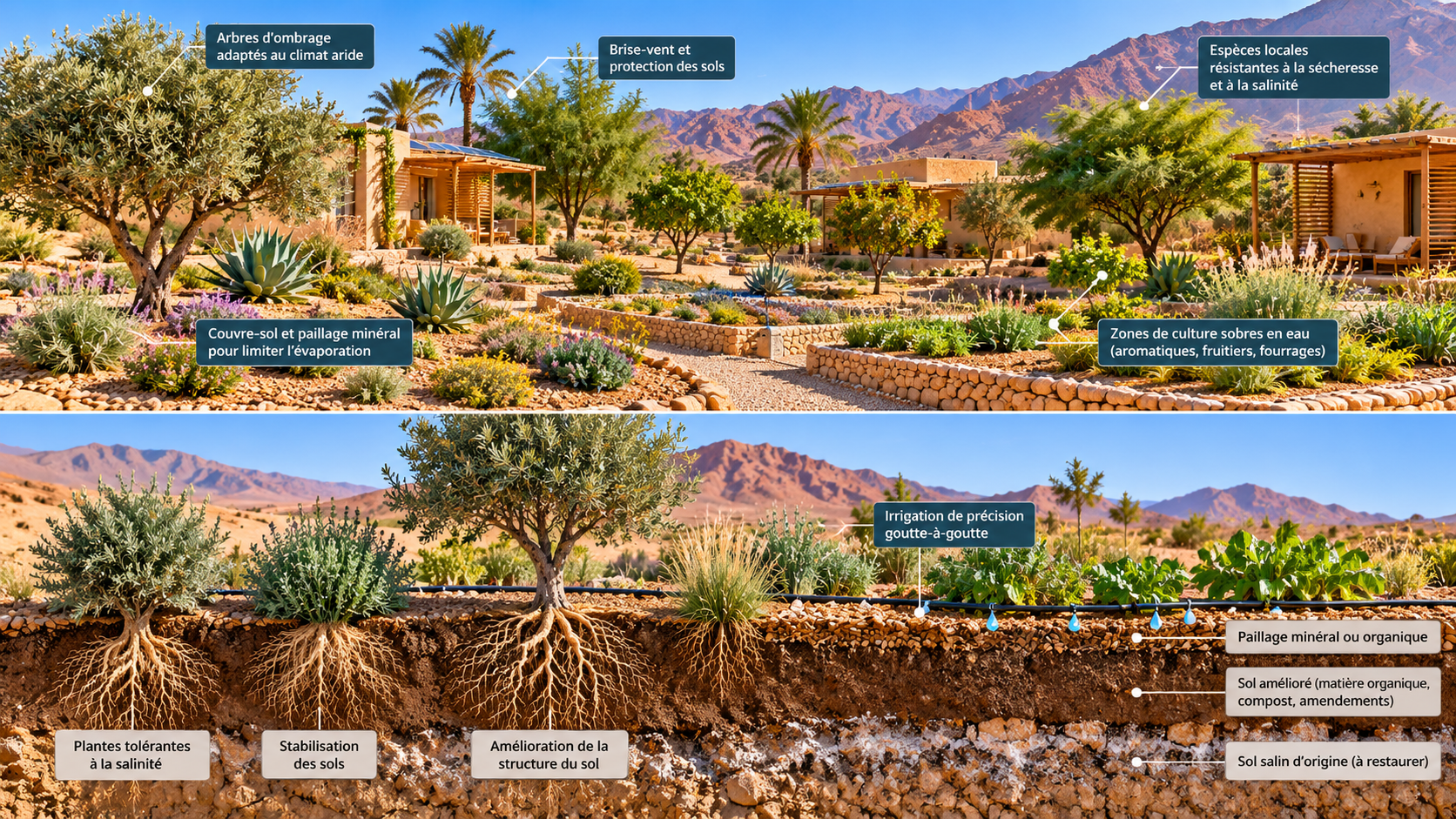
A concept combining shade trees, windbreak shrubs, groundcover, mulch and efficient irrigation to test vegetation suited to drought and salinity.
Soil restoration & precision irrigation
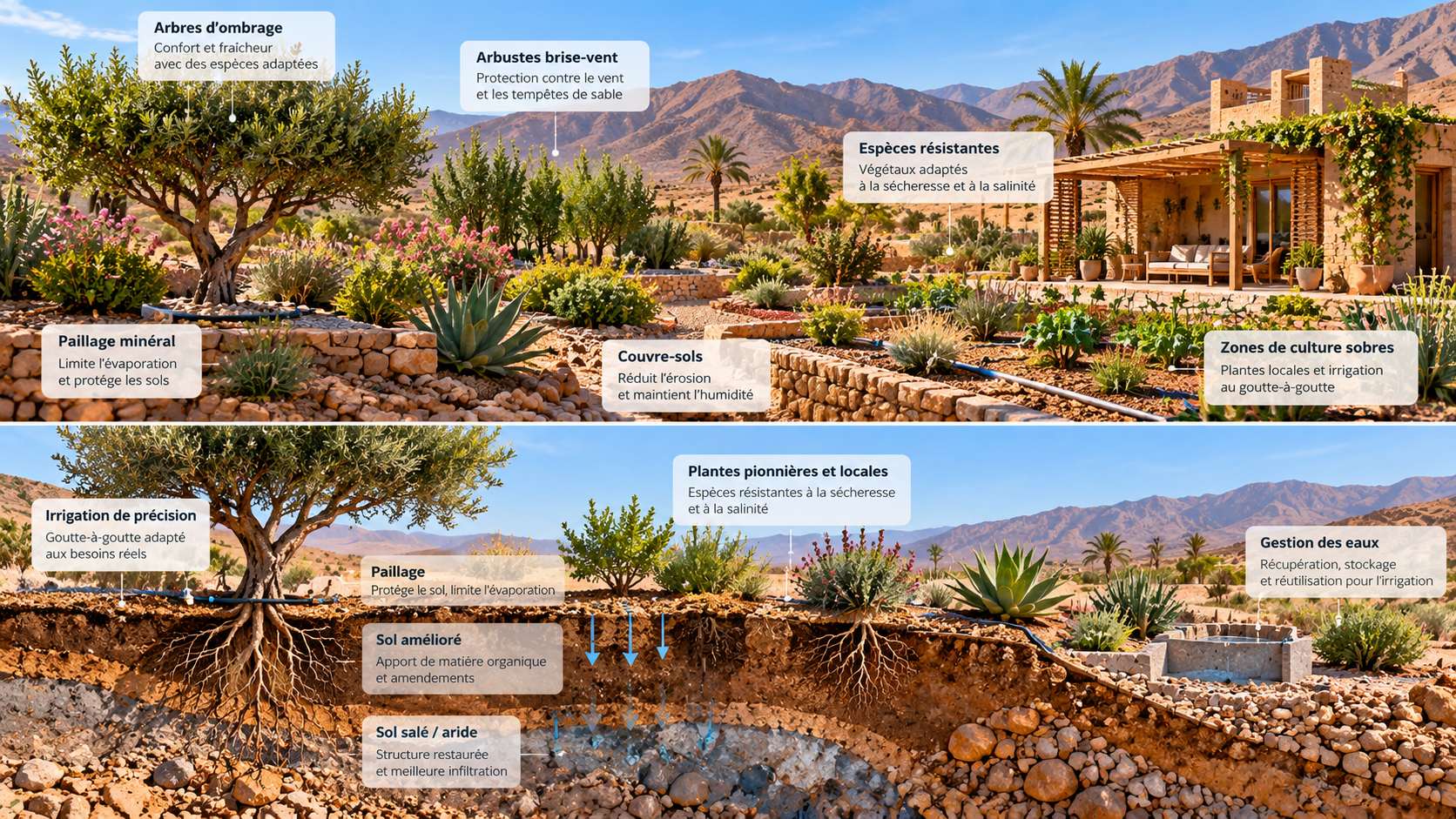
A concept showing mulching, amendments, drip irrigation, drainage and drought- and salt-tolerant planting.
WHY THIS CHALLENGE?
Introduce vegetation without wasting water or artificialising the environment.
Arid or saline soils severely limit plant choice and growth. Poorly adapted planting can require large amounts of water, become expensive to maintain and remain fragile during heat or wind events.
The project will instead seek to progressively rebuild healthier soils, select robust species and create useful microclimates around buildings.
Measurable objectives
• Soil salinity and structure
• Soil moisture
• Water consumption by area
• Plant survival
• Growth and vegetation cover
• Surface temperature
• Shading and windbreak effects
• Maintenance requirements
SOLUTIONS TO TEST
Rebuild a resource-efficient, useful and resilient ecosystem.
The demonstrator will compare combinations of soils, species, protection measures and irrigation methods to identify the most robust systems over time.
Resistant species
Select trees, shrubs and groundcovers able to withstand heat, drought, wind and, where relevant, salinity.
Mulching & soil protection
Reduce evaporation and surface temperatures using suitable organic or mineral mulches.
Amendments & living soils
Test compost, organic matter, biochar and other locally appropriate amendments to improve soil structure.
Drainage & salt management
Study drainage and salt-accumulation management where needed and technically justified.
Precision irrigation
Compare drip irrigation, subsurface irrigation, soil-moisture sensors and needs-based control.
Vegetated windbreaks
Create plant filters that protect living spaces, limit erosion and reduce sand transport.
Shade & microclimates
Position planting to shade façades, walkways and patios while improving outdoor comfort.
Comparative pilot plots
Create several test plots to compare species, substrates, irrigation methods and maintenance under the same climate conditions.
RESEARCH & DEVELOPMENT
Make the landscape a living laboratory.
The demonstrator will make it possible to track species survival, growth, water needs, effects on temperature and capacity to improve soils over time.
Partnerships may involve nurseries, agronomists, universities, landscape professionals, researchers, irrigation-system manufacturers and soil-restoration organisations.
Partners & Funders Wanted
We are looking for proven and experimental solutions for restoring soils, creating vegetation with very low water demand and building useful microclimates in arid territories.