CHALLENGE 01 • HEAT & HEATWAVES
Design comfortable buildings when heat becomes extreme.
At Guelmim, summer comfort should first come from design: orientation, solar protection, thermal mass, air movement and reduced energy demand. The demonstrator will test these approaches in genuinely occupied spaces.
BIOCLIMATIC SOLUTIONS TO TEST

A bioclimatic mini-villa combining shading, natural ventilation, a wind tower, high thermal mass and an earth-air heat exchanger.
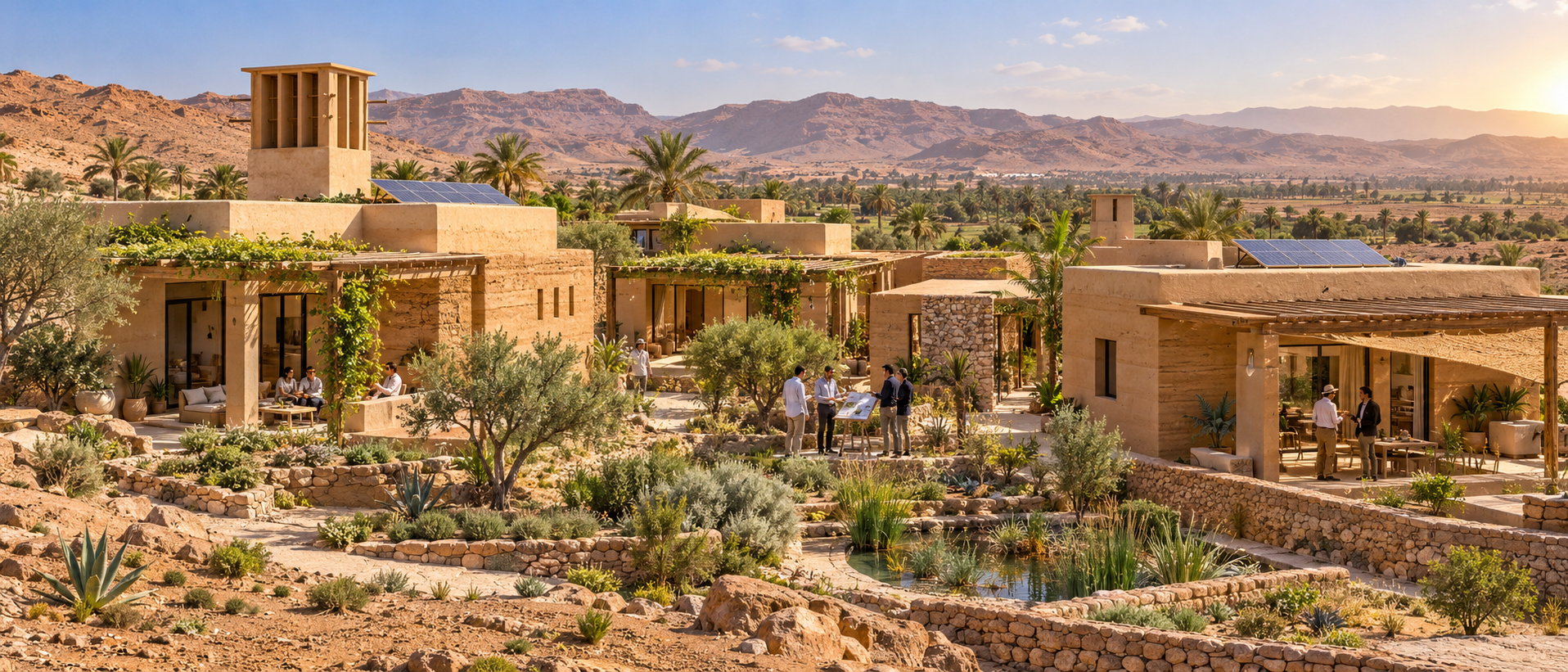
A full-scale habitable demonstrator bringing together several bioclimatic units and different climate-adaptation strategies.
WHY THIS CHALLENGE?
Heat cannot be addressed by air-conditioning alone.
In a hot, dry climate, the building itself can provide protection. Good orientation, effective shading, high thermal mass and appropriate ventilation can significantly reduce overheating before active cooling is needed.
The demonstrator will compare several combinations in order to identify the most robust, resource-efficient and maintainable options.
Measurable objectives
• Indoor temperature
• Surface temperature
• Humidity
• Air speed and air-change rate
• Energy use
• Occupant comfort
SOLUTIONS TO TEST
Several strategies will be combined and compared.
The solutions below provide a working basis. The programme will remain open to other relevant approaches proposed by architects, companies, manufacturers, researchers and engineering consultancies.
Orientation & site layout
Position openings carefully, reduce exposure on the hottest façades and use built volumes to create naturally protected zones.
Shading & solar protection
Pergolas, overhangs, external shading, patios and vegetation to reduce direct solar radiation on façades and living spaces.
Thermal mass
Compare compressed earth blocks, rammed earth, raw earth and other heavy wall systems able to slow and shift heat gains.
Cross-ventilation
Position openings and airflow paths to promote natural cooling when outdoor conditions allow.
Night ventilation
Use cooler night air to release stored heat and cool the building’s thermal mass.
Wind towers
Test systems inspired by traditional badgirs to capture and channel air, with or without light mechanical assistance.
Earth-air heat exchangers
Study ground-coupled air systems suited to local soil and climate conditions in order to pre-condition incoming air.
Roofs & building envelope
Compare insulation, colours, ventilated roofs, double skins, shading and, where relevant, low-water planted solutions.
CALL FOR SOLUTIONS
We are also looking for experimental approaches.
Oasis Terre et Eau wants to identify proven, emerging and experimental solutions capable of improving thermal comfort in hot and arid territories.
Proposals should be suitable for full-scale testing, instrumentation and documentation at the Guelmim demonstrator.
Do you have a solution?
Companies, architects, manufacturers, researchers and engineering consultancies are invited to present technologies, materials or approaches.