HERITAGE • REHABILITATING RAMMED-EARTH & STONE HOUSES
Rehabilitate historic houses to preserve skills and bring villages back to life.
Many traditional rammed-earth, raw-earth and stone houses are now weakened, vacant or abandoned. Yet they represent valuable architectural, climatic and cultural heritage.
Oasis Terre et Eau aims to test diagnostic, repair and rehabilitation methods compatible with these buildings, helping avoid systematic replacement by unsuitable solutions and encouraging their reuse.
REHABILITATION APPROACHES TO TEST
Traditional house before / after rehabilitation
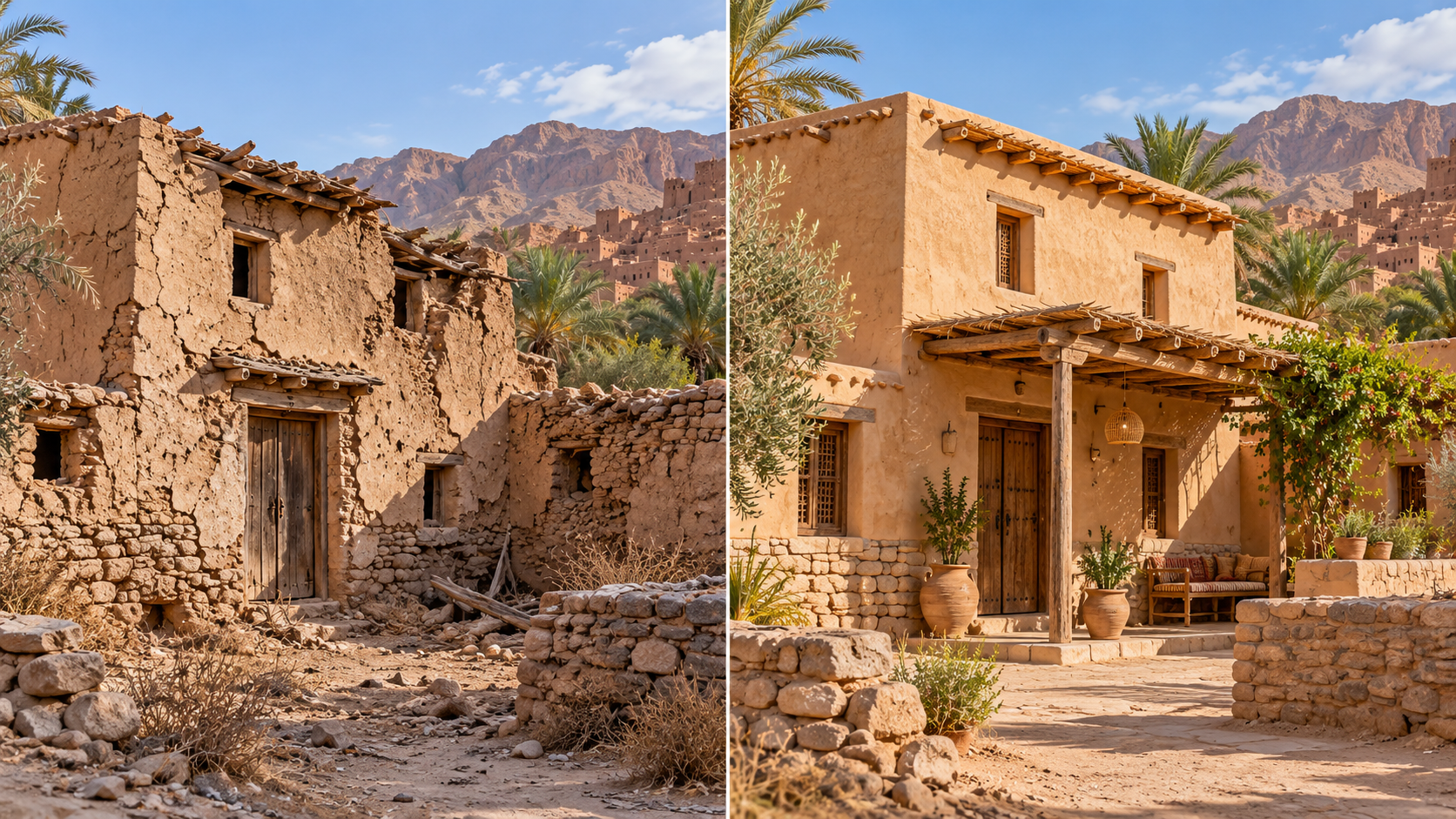
Concept illustration of an old rammed-earth and stone house before intervention and after respectful rehabilitation: wall consolidation, renewed renders, repaired roofing, adapted joinery and preservation of architectural character.
Construction details & traditional skills
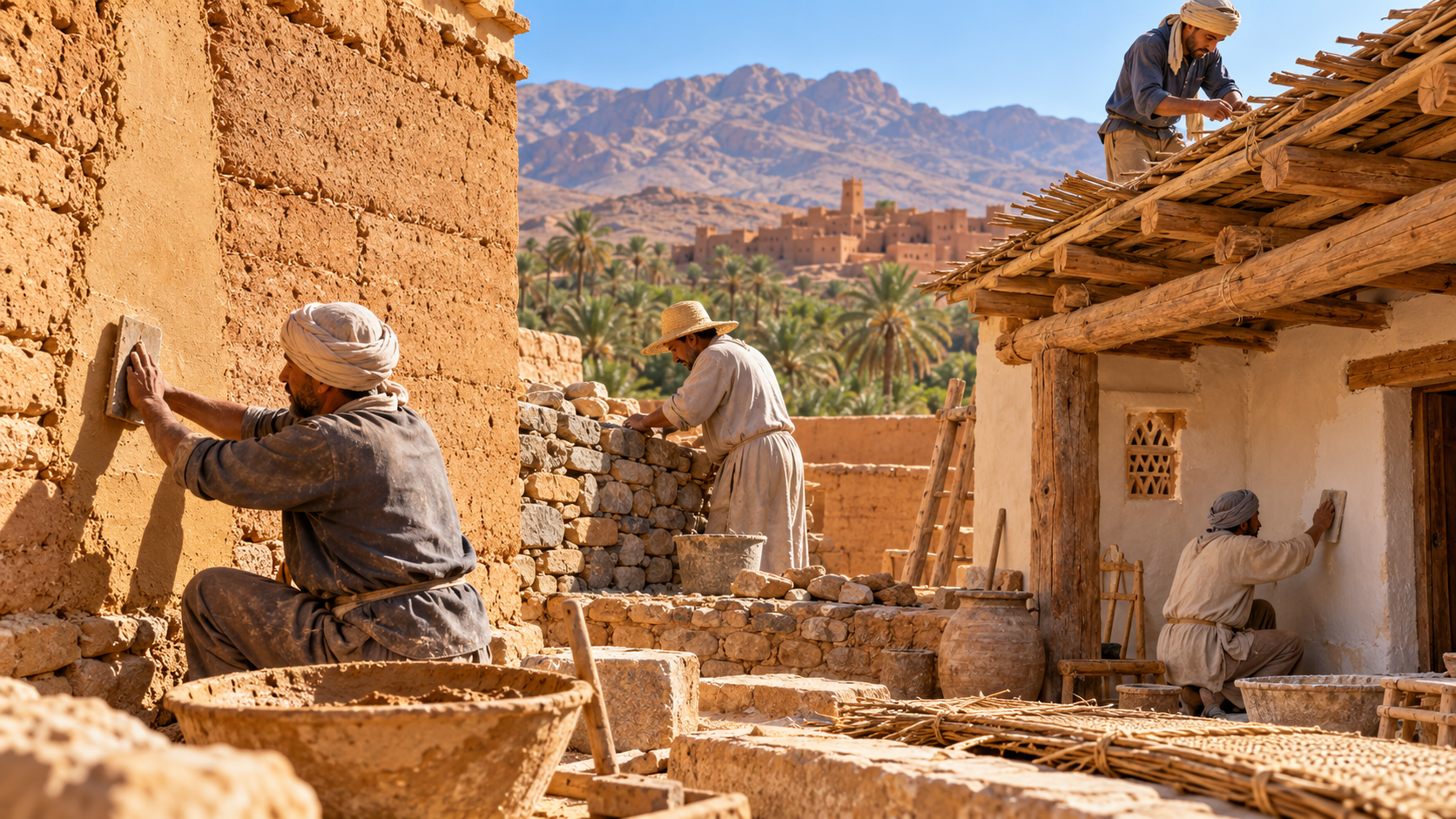
Concept illustration highlighting restoration techniques: rammed-earth repair, stone repointing, earth or lime renders, treatment of wall bases, roof repair and discreet comfort improvements.
WHY THIS CHALLENGE?
Rehabilitate without erasing the building’s identity.
Restoring an old building does not mean turning it into a new building. Materials must remain compatible with existing walls in order to preserve moisture exchange, thermal mass and structural behaviour.
The demonstrator can also support knowledge transfer, practical training and comparison between traditional techniques and reversible contemporary improvements.
Measurable objectives
• Structural condition of walls
• Moisture and defects
• Thermal comfort before / after
• Rehabilitation cost
• Share of local materials
• Maintenance duration and ease
• Material reuse
• Occupant satisfaction
SOLUTIONS TO TEST
Restore, improve and reoccupy existing heritage.
Solutions will be assessed for compatibility with existing buildings, resource efficiency, cost, ability to mobilise local craftspeople and potential for replication in other villages or historic centres.
Historic-building diagnosis
Identify cracks, settlement, moisture, wall erosion and incompatible previous interventions.
Rammed-earth repair
Test localised repairs, material rebuilding, stitching and protection suited to earthen walls.
Stone masonry
Preserve, repair and repoint old stone masonry using compatible mortars.
Breathable renders
Compare earth and lime renders and finishes compatible with the moisture behaviour of existing walls.
Wall bases & water
Limit rising damp, runoff and deterioration at the base of walls.
Traditional roofs
Repair or rebuild roofs using durable, insulating solutions suited to heritage buildings.
Reversible comfort improvements
Improve shading, ventilation, targeted insulation and joinery without altering the building’s character.
Reuse & training
Reuse materials where possible and organise training worksites to pass on practical skills.
RESEARCH & DEVELOPMENT
Create a laboratory for rehabilitating earthen heritage.
Historic buildings may support diagnostic campaigns, training worksites and before/after monitoring protocols.
The objective is to produce simple, documented and replicable methods that help owners, municipalities, craftspeople and associations preserve this heritage rather than abandon it.
Craftspeople, architects, municipalities & funders wanted
We are looking for owners, specialist craftspeople, architects, schools, public authorities, foundations and funders interested in pilot conservation and rehabilitation projects.