CHALLENGE 03 • WATER SCARCITY & REUSE
Treat every litre of water as a resource to preserve, measure and reuse.
In an arid territory, water has to be treated as a critical resource from the earliest design stage. The demonstrator will test solutions for reducing demand, collecting, storing, treating, reusing and efficiently applying water.
The existing well can also become a case study. Its water is currently poor-quality/saline, creating an opportunity to assess appropriate treatment solutions before any possible use.
WATER SYSTEMS TO TEST
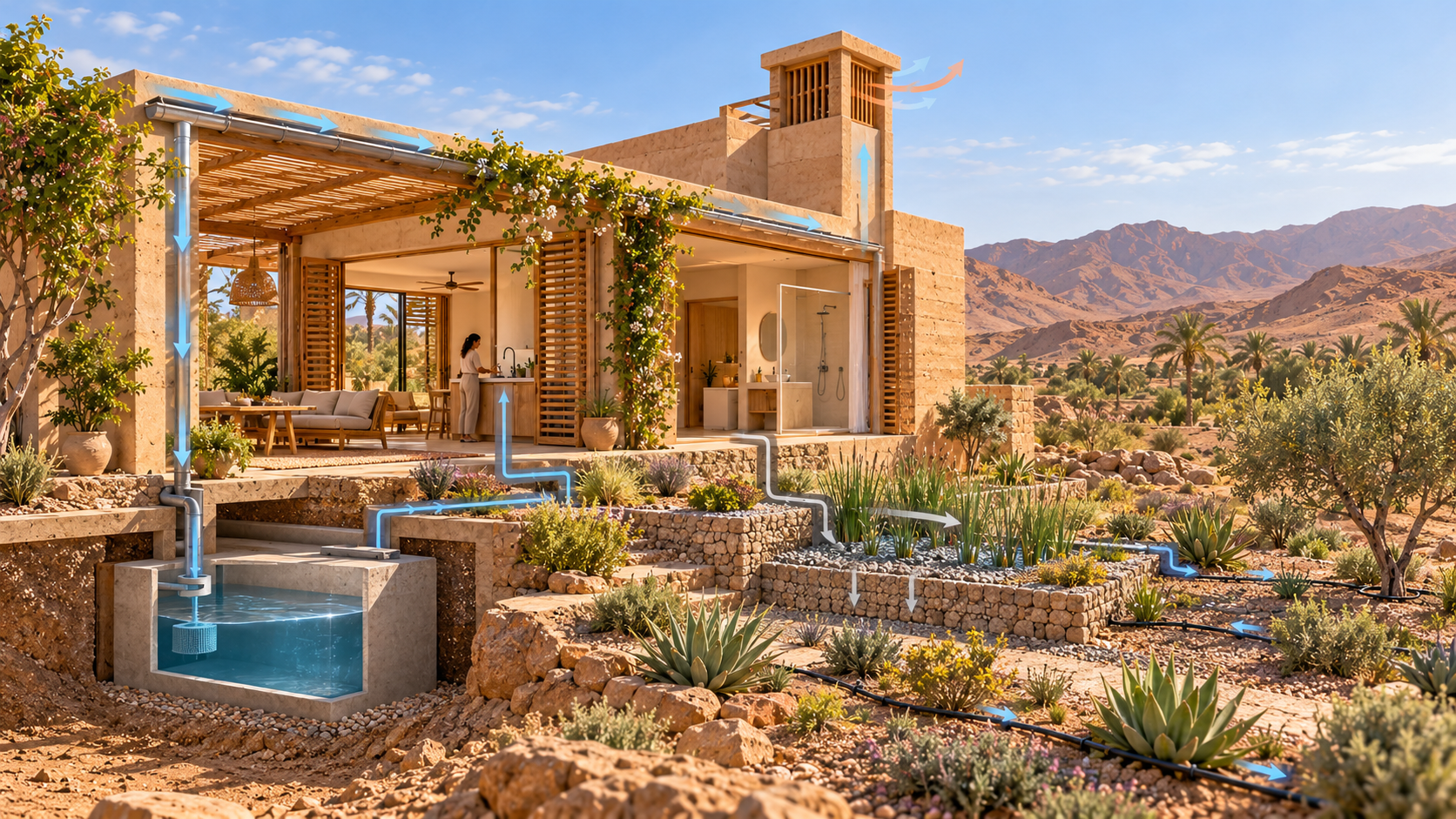
An integrated water cycle at the scale of a habitable unit: collection, storage, efficient use, greywater treatment and targeted reuse for irrigation.
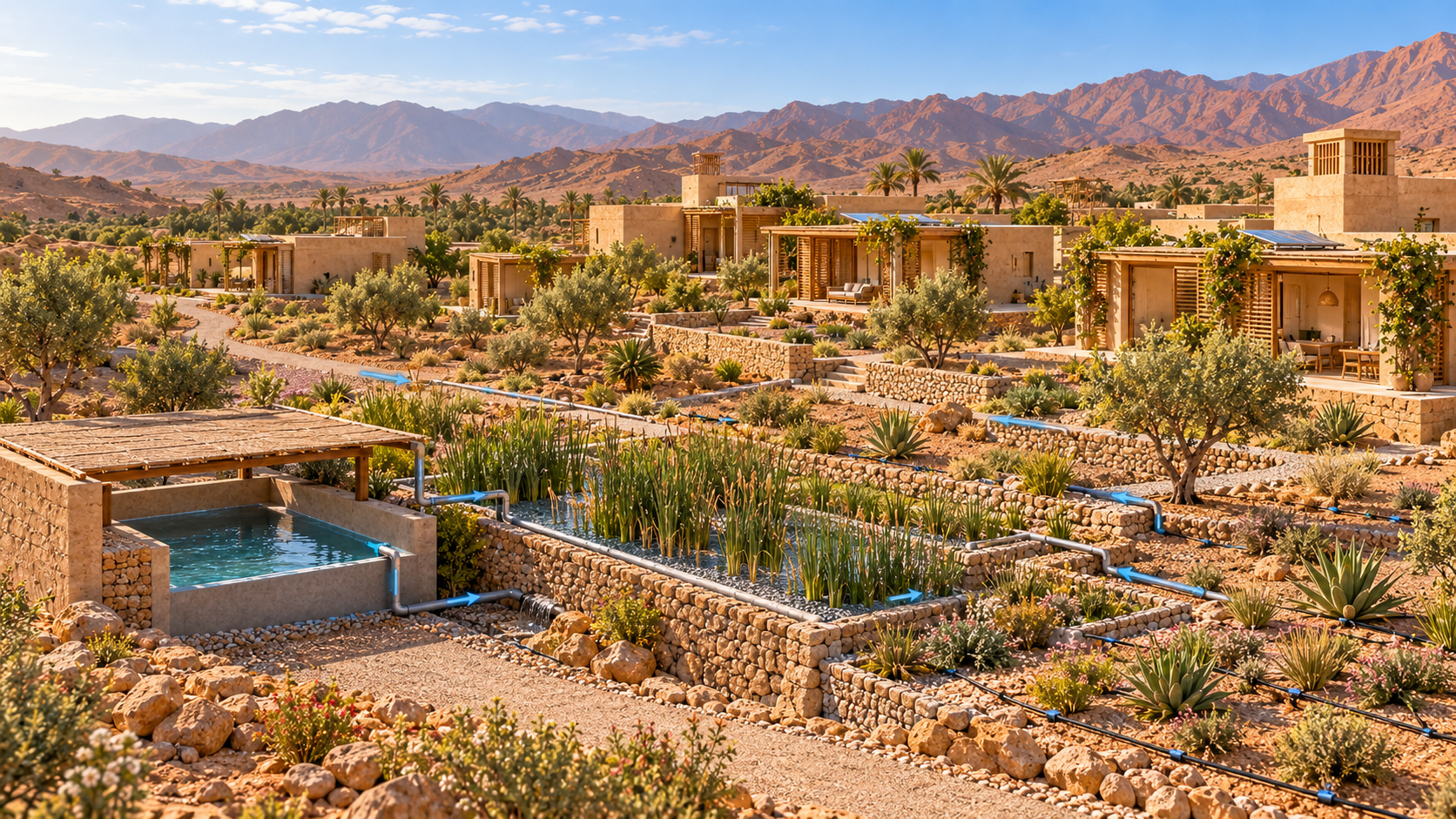
A demonstrator combining water storage, planted treatment, precision irrigation and vegetation suited to an arid climate.
WHY THIS CHALLENGE?
Water efficiency must be built into every use.
The demonstrator will seek to reduce demand before producing or treating more water. Uses, equipment, planting and irrigation systems will therefore be designed to consume as little as possible.
Solutions will be assessed not only for technical performance, but also for cost, maintenance, robustness and their ability to be replicated in other water-stressed territories.
Measurable objectives
• Water use by end use
• Collected and stored volumes
• Greywater reuse rate
• Water quality before and after treatment
• Irrigation demand
• Treatment energy use
• Maintenance cost and frequency
SOLUTIONS TO TEST
Reduce, collect, treat, reuse and irrigate with precision.
The site will compare several options, from the simplest device to more advanced systems, while prioritising efficiency, local maintenance capacity and health protection.
Water-efficient equipment
Reduce flow rates and demand at source with taps, showers, toilets and equipment suited to actual use.
Rainwater harvesting
Capture rare rainfall events from suitable roofs and surfaces, then store the water for compatible uses.
Smart storage
Compare buried and above-ground tanks, evaporation protection, level monitoring and reserve management.
Greywater reuse
Test reuse of shower and washbasin water after appropriate treatment, with clear separation between uses and health risks.
Phytoépuration
Evaluate planted filters and vegetated treatment systems suited to the local climate, including their effectiveness and maintenance requirements.
Low-water irrigation
Drip irrigation, mulching, needs-based control, targeted watering and low-demand plant selection.
Saline-water treatment
Study solutions suited to the actual quality of the well water: pre-treatment, filtration or desalination depending on analyses and intended uses.
Measurement & control
Install meters and sensors by use to detect losses, compare systems and progressively improve performance.
RESEARCH & DEVELOPMENT
Make the water cycle a full-scale laboratory.
Systems can be instrumented to monitor volumes, quality, energy, costs and maintenance. The results can be used to compare scenarios and identify solutions genuinely suited to arid territories.
The programme will remain open to technologies and processes proposed by universities, companies, manufacturers, engineering consultancies and water operators.
Partners & Funders Wanted
We are looking for technical, scientific and financial partners to test water-efficiency, treatment and reuse solutions at full scale.